 Latest Breaking News Online News Portal


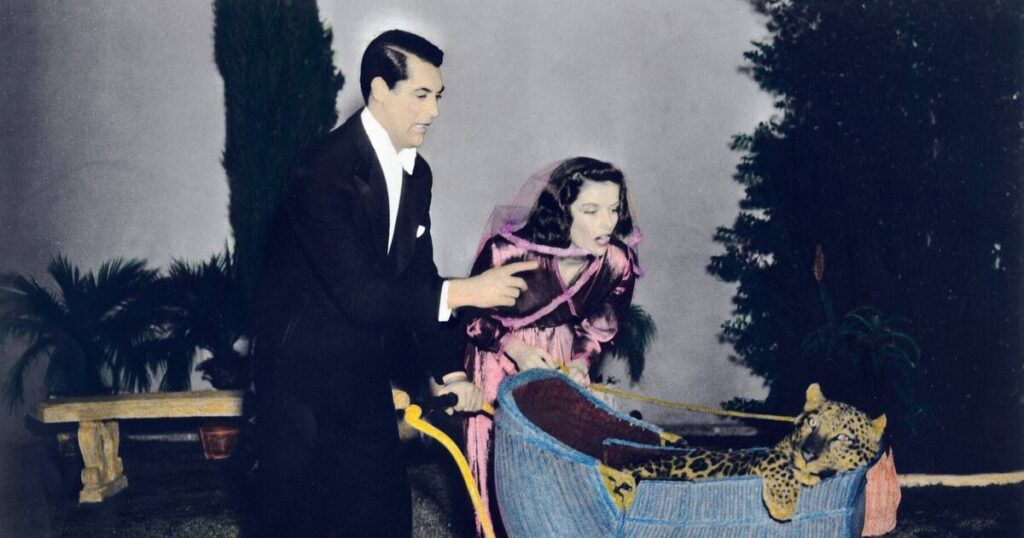

Katharine Hepburn and Cary Grant (Image: FilmPublicityArchive/United Archives via Getty Images)
The idea for this classic film starring two of Hollywood’s greatest ever stars originated as a short story by Hagar Wilde.
The tale was published in the magazine Collier’s Weekly and adapted for the big screen by Wilde and Dudley Nicholls.
Originally released over six decades ago, this madcap comedy continues to captivate audiences to this day – and it’s available to stream now on BBC iPlayer.
Bringing up Baby features Hollywood heavyweights Katharine Hepburn and Cary Grant in the principal roles as a scatterbrained heiress and an academic whose lives intersect through a quirk of fate.
The film’s other star is a genuine leopard, portraying Baby and actually appearing on set during numerous scenes alongside the performers.
The screwball comedy epitomises the period and while it garnered a mixed reception upon release, it has since achieved classic status.
When broadcast on television during the 1950s, its popularity soared, and in 1990 it earned recognition for its cultural, historical and aesthetically significant contributions, securing preservation in the National Film Registry in America.

Cary Grant and Katharine Hepburn in Bringing Up Baby (Image: Corbis via Getty Images)
It maintains devoted followers today and you can discover why for yourself as it’s presently streaming on BBC iPlayer.
Palaeontologist Dr David Huxley (Grant) has spent the previous four years reconstructing a dinosaur skeleton but remains short of just one bone.
He is additionally preoccupied with attempting to impress a prospective benefactor for his museum, Elizabeth Random (May Robson), and his forthcoming marriage to Alice Swallow (Virginia Walker).
The day prior to his wedding, he experiences a chance meeting with the absent-minded Susan Vance (Hepburn) when she inadvertently strikes his ball on the golf course.

Actress Katharine Hepburn (Image: Corbis via Getty Images)
Convinced he is a zoologist, she manipulates him into helping her in transporting a leopard named Baby back to her farm.
The creature, which was dispatched by her brother from Brazil, is reasonably docile, though it responds particularly well upon hearing the song I Can’t Give You Anything but Love, Baby.
Once back at her home, Susan falls head over heels for David and is determined to derail his upcoming wedding. What follows is a succession of slapstick moments and chaotic scenes as the duo find themselves embroiled in one farcical predicament after another.
While the screenplay was crafted specifically with Hepburn’s personality in mind, it marked her debut in a comedic role, and she required considerable guidance to find her footing.
Grant similarly received additional assistance in portraying a doctor convincingly.
Nevertheless, both actors reportedly had a wonderful time on set, with their uncontrollable bouts of laughter during filming cited as a contributing factor to the production running over budget and behind schedule.
Their evident enjoyment of the characters and storyline appears to have proved contagious, with audiences continuing to cherish the film to this day.
Fans have shared their thoughts on Rotten Tomatoes, where it holds a remarkable 97% score.

Katharine Hepburn and Cary Grant (Image: FilmPublicityArchive/United Archives via Getty Images)
One said: “An absolute classic. This movie is in my top 20 list. 200 mile an hour comedy, every line a laugh, it never lets up. One of the best movies ever made.””
Another film buff wrote: “It’s a wild ride, with Cary Grant as a paleontologist, Hepburn as a zany heiress – and a leopard, the baby of the film’s title. Does it necessarily make sense? No. Is it brilliant in spite of that? Indeed.”””
A third noted the change of direction for Hepburn: “This is “down-to-earth” farce with liberal flashes of slapstick, and the surprise performance comes from Katharine Hepburn,” they said. “She turns in a breezy performance that is different and incomparable with anything she has done before.”